

[[{“value”:”After years of moving less, everyday movement can feel different than you remember. Getting down to the floor may take more effort, or your legs may tire sooner when you’re up and moving. That doesn’t mean you need to jump straight into hard workouts. You need to give your body regular reasons to get stronger and regain more range of motion.
Yoga can be a great way to improve mobility and get comfortable moving, especially after a long layoff. When I coach older adults coming back from inactivity, though, I also want some direct strength work in the plan. Rebuilding lost capacity usually works better when muscles support your body weight and gradually take on more work over time.
That’s what this routine is built around. You’ll move enough to loosen up, then ask the muscles to do something with that new range. Keep the first few sessions comfortable and focus on making each exercise feel more natural before you worry about doing more.
RELATED: 5 Exercises That Restore the Strength You Had at 50 After 70
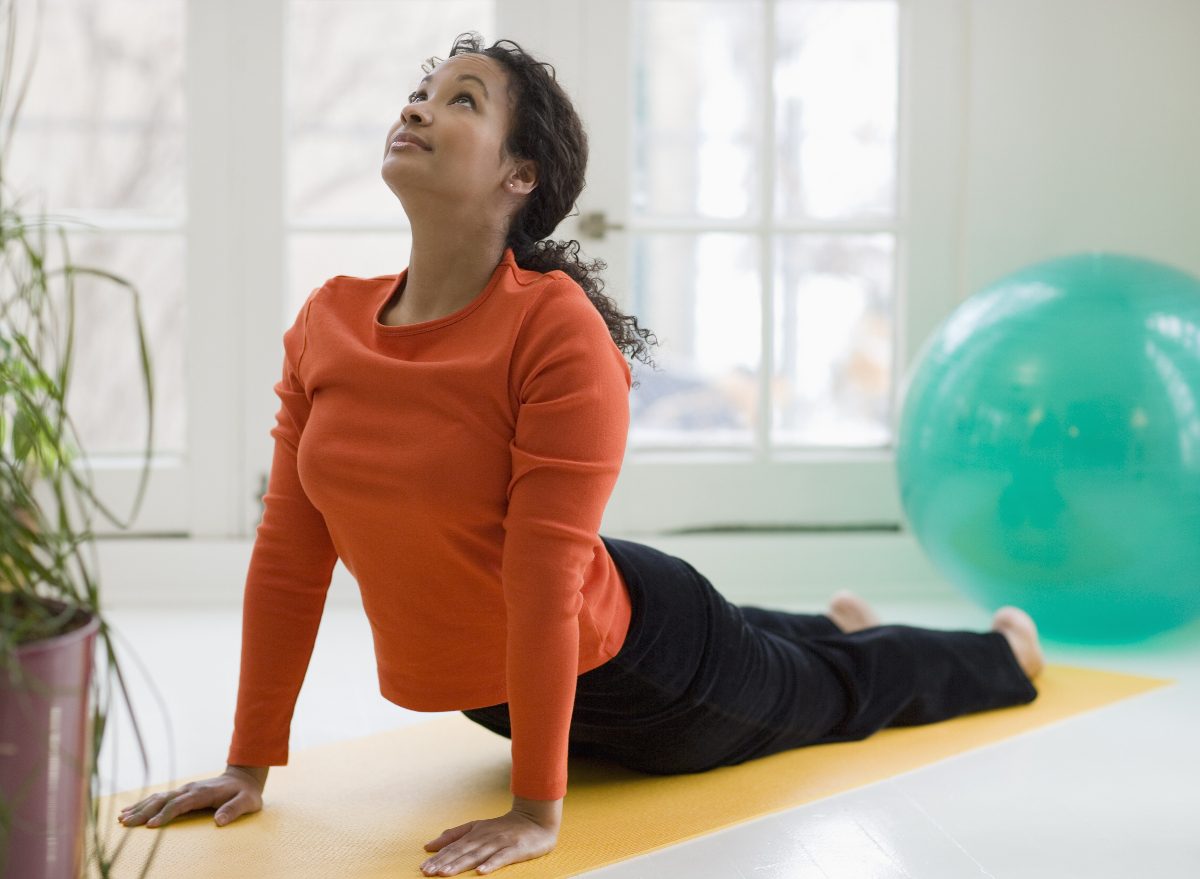
Down Dog to Cobra
Down Dog to Cobra is a good first move because it gets you changing positions instead of staying in one place. Your shoulders and spine move through a larger range while your core helps control the transition. If you’ve spent years doing less, that alone can feel useful without turning it into a stretch session.
Muscles Trained: Shoulders, core, upper back, glutes.
How to Do It
Start in a high plank position.
Push your hips up and back into Down Dog.
Press your chest gently toward your thighs.
Shift your body forward.
Lower your hips toward the floor as you lift your chest into Cobra.
Reverse the movement and repeat.
Recommended Sets and Reps: Perform 2 to 3 sets of 6 to 10 reps. Rest for 30 to 45 seconds.
Best Variations: Shorter-range Down Dog to Cobra, elevated version, slow-tempo version.
Form Tip: Move only through a range that feels comfortable through your shoulders and lower back.
Forward Lunge With Overhead Reach
This one asks you to cover more ground with each rep. The lunge challenges your legs to control the step and return to standing, while the overhead reach encourages you to open up through a range that often gets overlooked during the day. Shorten the step if you need more control at first.
Muscles Trained: Quads, glutes, hamstrings, shoulders.
How to Do It
Stand tall with your feet about hip-width apart.
Step your right foot forward.
Bend both knees into a comfortable lunge.
Reach both arms overhead.
Lower your arms and press through your front foot to return.
Switch sides and continue alternating.
Recommended Sets and Reps: Perform 2 to 3 sets of 6 to 8 reps per side. Rest for 45 seconds.
Best Variations: Supported forward lunge, reverse lunge with reach, shorter-range lunge.
Form Tip: Use a step length that lets you return to standing under control.
RELATED: The 10-Minute Standing Routine That Reverses Muscle Loss After 65
Kneeling Side Plank Hold
A long break from training often means the core hasn’t had to support much beyond normal daily movement. The kneeling side plank gives the muscles along your trunk a manageable place to start. You can build the hold over time without needing to jump straight into a full side plank.
Muscles Trained: Obliques, shoulders, glutes.
How to Do It
Lie on your side with your knees bent.
Place your elbow beneath your shoulder.
Keep your knees stacked.
Press your forearm into the floor.
Lift your hips until your body forms a straight line from your knees through your shoulders.
Hold, then switch sides.
Recommended Sets and Reps: Perform 2 to 3 holds of 15 to 30 seconds per side. Rest for 30 seconds.
Best Variations: Shorter hold, full side plank, side plank with top-leg lift.
Form Tip: Keep your hips stacked as you hold the position.
Bodyweight Box Squat
Few movements tell you as much about your lower-body strength as sitting down and standing back up. The box squat lets you practice that pattern with a consistent target, making it easier to see when your control improves. Once the current height feels easy, you can lower the box or add resistance.
Muscles Trained: Quads, glutes, hamstrings, core.
How to Do It
Stand in front of a sturdy box or chair.
Set your feet about shoulder-width apart.
Reach your arms forward.
Sit your hips back and bend your knees.
Lower until you lightly touch the box.
Press through your feet to stand.
Recommended Sets and Reps: Perform 2 to 3 sets of 8 to 12 reps. Rest for 45 to 60 seconds.
Best Variations: Higher box squat, lower box squat, goblet box squat.
Form Tip: Touch the box lightly instead of relaxing onto it.
RELATED: 4 Daily Exercises That Restore Knee Strength Better Than Squats After 65
Plank With Shoulder Taps
Shoulder taps challenge your body to handle small movements while you stay braced. Each time one hand leaves the floor, your core has to keep the rest of you from shifting too much. Widen your feet or use an incline if the full plank makes it hard to stay in control.
Muscles Trained: Abs, shoulders, chest, glutes.
How to Do It
Start in a high plank with your hands beneath your shoulders.
Set your feet slightly wider than hip-width apart.
Brace your abs.
Lift your right hand and tap your left shoulder.
Return your hand to the floor.
Switch sides and continue alternating.
Recommended Sets and Reps: Perform 2 to 3 sets of 6 to 10 taps per side. Rest for 30 to 45 seconds.
Best Variations: Incline shoulder taps, kneeling shoulder taps, narrower-stance shoulder taps.
Form Tip: Keep your hips level as each hand leaves the floor.
RELATED: 5 Couch Exercises That Flatten Belly Sag Faster Than Crunches After 65
Give Your Body Time to Catch Back Up
You’re not trying to make up for 10 inactive years in a month. The win is getting stronger enough that movements which felt awkward at first start feeling familiar again.
Start with ranges you can control: Let comfort improve before you push deeper.
Add work gradually: A few extra reps can be enough progression early on.
Keep moving between workouts: Walking is an easy way to rebuild general activity.
Repeat the routine consistently: Two to three sessions per week gives you plenty of practice.
Use easier variations when needed: Scaling a movement keeps you training without forcing it.
References
Szychowska, Agnieszka, and Wojciech Drygas. “Physical activity as a determinant of successful aging: a narrative review article.” Aging Clinical and Experimental Research vol. 34,6 (2022): 1209-1214. doi:10.1007/s40520-021-02037-0
Mayer, Frank et al. “The intensity and effects of strength training in the elderly.” Deutsches Ärzteblatt International vol. 108,21 (2011): 359-64. doi:10.3238/arztebl.2011.0359
The post 5 Exercises That Undo 10 Years of Inactivity Faster Than Yoga After 65 appeared first on Eat This Not That.”}]]