

[[{“value”:”Sit-ups can strengthen your abs, but they only train one small part of what it takes to tighten your midsection. After 65, you’ll usually get more from exercises that keep your core working while the rest of your body moves too. That gives you a better mix of strength and calorie-burning effort.
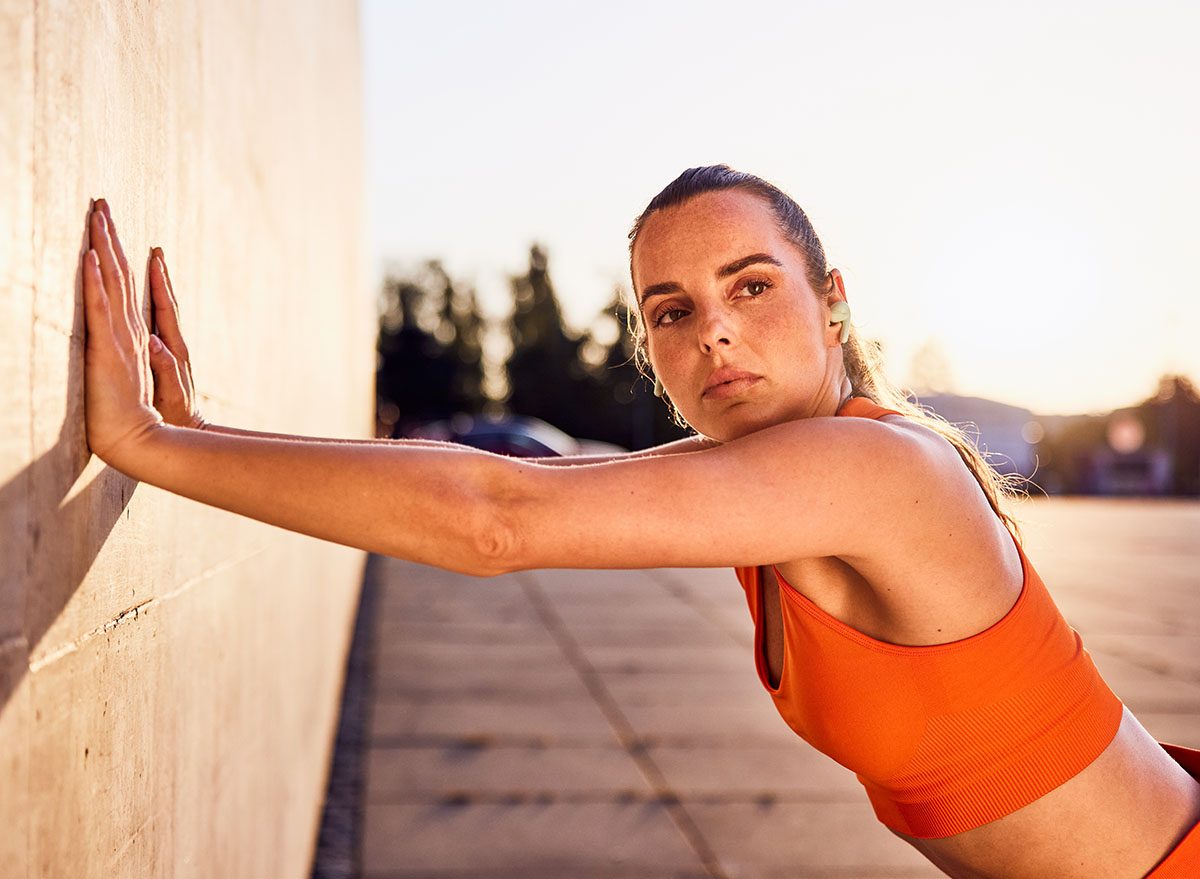
A wall makes that easier than it sounds. It gives you support when balance is a concern and lets you train your abs standing or in an inclined position. You can also adjust the challenge quickly by changing your stance or how far you are from the wall.
I use setups like this with older clients because they make core work feel approachable without stripping away the challenge. You still have to brace, rotate, and control your body. The wall just gives you a little more confidence while you do it.
For this routine, you’ll use the wall in four different ways. One move combines lower-body strength with rotation, another focuses on bracing, and the final two add more movement so your abs have to stay active while your heart rate climbs.
Wall Sit With Med Ball Rotation
The wall sit engages your thighs and glutes right away, giving the exercise more total-body demand than a sit-up. Holding a medicine ball adds load through your upper body, and the rotation asks your obliques to control the turn. It’s a good choice when you want your core work to feel more like a full workout, not just a few isolated ab reps.
Muscles Trained: Quads, glutes, abs, obliques.
How to Do It
Stand with your back against a wall.
Walk your feet forward and slide down into a comfortable wall sit.
Hold a light medicine ball in front of your chest.
Rotate your chest and the ball slightly to the right.
Return to center, then rotate to the left.
Continue alternating sides while holding the wall sit.
Recommended Sets and Reps: Perform 2 to 3 sets of 6 to 10 rotations per side. Rest for 45 to 60 seconds.
Best Variations: Bodyweight wall sit, smaller med ball rotation, higher wall sit.
Form Tip: Keep your back against the wall as you rotate.
RELATED: 5 Home Exercises That Reverse Muscle Loss Better Than Lifting Weights After 65
Wall Plank
Your abs spend a lot of time keeping your body from moving when they shouldn’t. That’s exactly what a wall plank trains. Once you step your feet back, your core has to keep your ribs and hips lined up while your shoulders support the position. Move farther from the wall for more challenge, or step closer when you need to make the hold easier.
Muscles Trained: Abs, shoulders, chest, glutes.
How to Do It
Stand facing a wall.
Place your forearms against the wall at about shoulder height.
Step your feet backward.
Create a straight line from your head through your heels.
Brace your abs.
Hold the position while breathing normally.
Recommended Sets and Reps: Perform 2 to 3 holds of 20 to 40 seconds. Rest for 30 to 45 seconds.
Best Variations: Higher wall plank, wall plank with shoulder taps, incline plank on a counter.
Form Tip: Keep your ribs stacked over your hips.
Wall Marching
Marching changes the challenge because you have to keep your torso steady while one foot leaves the floor. That weight shift brings your abs into the movement and gives your hips useful work at the same time. The wall lets you stay focused on strong knee drives without worrying as much about balance. Pick a pace you can control and let it build as the set goes on.
Muscles Trained: Abs, hip flexors, glutes, quads.
How to Do It
Stand facing a wall.
Place both hands against the wall at chest height.
Step back slightly and lean into your hands.
Lift your right knee toward your chest.
Lower your foot and lift your left knee.
Continue alternating at a steady pace.
Recommended Sets and Reps: Perform 2 to 3 rounds of 20 to 40 seconds. Rest for 30 to 45 seconds.
Best Variations: Slower wall march, higher knee march, alternating wall knee drive.
Form Tip: Bring each foot back underneath you before switching sides.
RELATED: 6 Bodyweight Exercises That Sculpt Abs Faster Than Weights After 50
Incline Mountain Climber
If you want the routine to finish with more energy, incline mountain climbers are the move. Your abs have to stay braced while your legs keep cycling underneath you, and that extra movement pushes your breathing up fast. It gives you the core work you’re after while adding more conditioning than a set of sit-ups usually provides. Start slower, then speed up only if your position stays solid.
Muscles Trained: Abs, hip flexors, shoulders, chest, quads.
How to Do It
Place your hands against a wall or sturdy elevated surface.
Step your feet back into an incline plank.
Brace your abs.
Drive your right knee toward your chest.
Return your foot to the floor and switch legs.
Continue alternating for the full interval.
Recommended Sets and Reps: Perform 2 to 3 rounds of 20 to 40 seconds. Rest for 30 to 45 seconds.
Best Variations: Slow incline mountain climber, higher incline mountain climber, alternating incline knee drive.
Form Tip: Keep your upper body steady as your legs move.
RELATED: 4 Walking Exercises That Strengthen Knees Better Than Gym Equipment After 60
How to Use This Wall Routine to Tighten Your Midsection After 65
A stronger core can help your stomach feel firmer, while changes in belly fat come from your overall routine. Use these exercises two to four days per week and give yourself several weeks of consistent work before judging the result.
Start with two rounds: Give yourself enough work to feel challenged without turning the first week into a marathon.
Add time before adding difficulty: Build a few extra seconds into planks, marches, and mountain climbers before moving to harder versions.
Keep full-body strength in your week: Training your legs and upper body helps you preserve muscle while working toward a leaner waist.
Walk often: Regular walks are an easy way to increase daily movement and support your body-composition goal.
Keep protein in your meals: Adequate protein helps support muscle while you work on reducing body fat.
Watch your waist over time: Measure every couple of weeks so you’re tracking a trend, not day-to-day changes.
Keep the routine easy to repeat: Consistency will do more for your midsection than one hard workout followed by a long break.
References
Cox, Carla E. “Role of Physical Activity for Weight Loss and Weight Maintenance.” Diabetes Spectrum: A Publication of the American Diabetes Association vol. 30,3 (2017): 157-160. doi:10.2337/ds17-0013
Thyfault, John P., and Audrey Bergouignan. “Exercise and metabolic health: beyond skeletal muscle.” Diabetologia vol. 63,8 (2020): 1464-1474. doi:10.1007/s00125-020-05177-6
Garatachea, Nuria et al. “Exercise attenuates the major hallmarks of aging.” Rejuvenation Research vol. 18,1 (2015): 57-89. doi:10.1089/rej.2014.1623
The post 4 Wall Exercises That Flatten Belly Sag Faster Than Sit-Ups After 65 appeared first on Eat This Not That.”}]]