


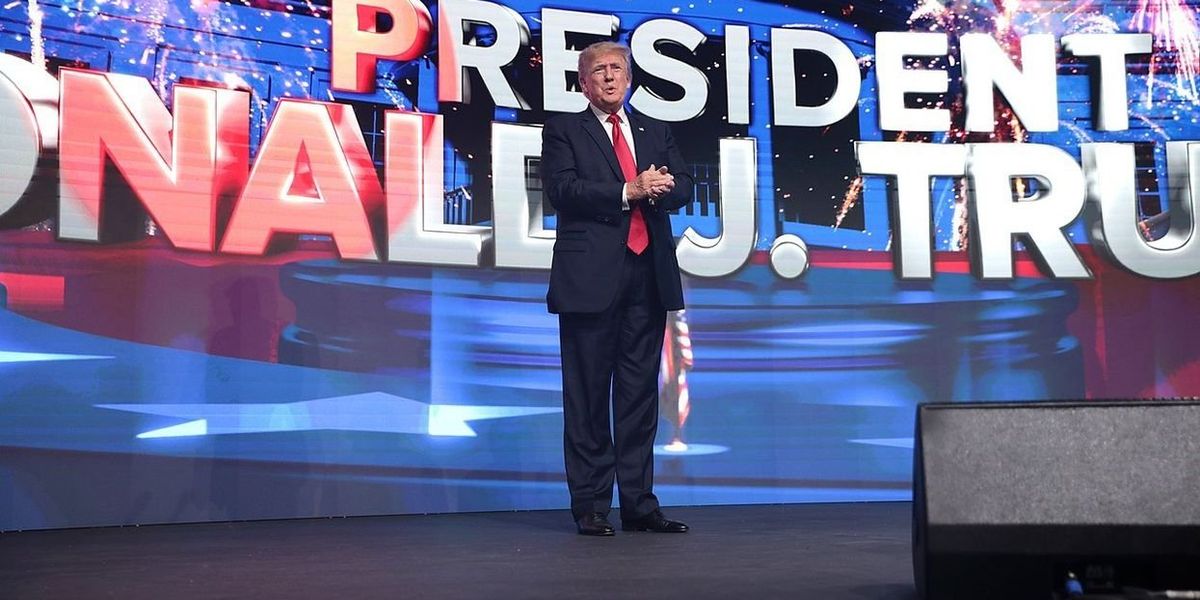
President Donald Trump has recently taken to accusing his foes of being communists, so much so that social activist Ralph Nader described the Republican leader as “Senator Joe McCarthy on steroids, who in the 1950s smeared political opponents, activists, and others, falsely accusing them of being communists.”
Yet according to The Washington Post, a newspaper owned by Trump ally Jeff Bezos, the president himself is acting quite a bit like a communist — at least when it comes to the government taking charge of private businesses.
“President Donald Trump is warning of a ‘resurgence of the communist menace’ as the Democratic Party shifts to the left, invoking historical memories of terror, collectivization and poverty in a bid to regain voter support ahead of the November congressional elections,” wrote The Washington Post’s David J. Lynch on Sunday. From there, Lynch went into detail through the right-winger’s presidency to point out a contradiction in his argument.
“Trump’s aversion to the heavy hand of the state has not kept him from wielding it himself,” the reporter explained. “The president has had the federal government take partial ownership of nearly two dozen companies since he returned to the White House, including chipmaker Intel and MP Materials, a leading producer of rare earth minerals.”
He added, “Outside of war or financial crisis, Washington has never been so eager to buy stakes in private companies. Critics warn that state capitalism is a recipe for cronyism, waste and inefficiency. But some businesses are volunteering to partner with the government. OpenAI, which is eyeing an initial stock offering later this year, this month offered to give Washington a 5 percent stake when it lists.”
Lynch also quoted Scott Lincicome, vice president of general economics at the libertarian think tank the Cato Institute, a libertarian think tank.
“Far from being a bulwark against creeping American communism, Trump is laying the groundwork for more of this in the future,” Lincicome told Lynch. “The president himself has said that he thinks it’s very American to take these government equity stakes based on what the country needs. It’s almost comical how much that sounds like ‘seizing the means of production’ [or] ‘to each according to his needs.’”
As one example of Trump’s socializing private businesses, Lincicome wrote that the president “obtained a 10 percent share of chipmaker Intel after the president publicly criticized Lip-Bu Tan, the company’s CEO, and suggested he be fired. Tan emerged from a private White House meeting a few days later having agreed to surrender a minority stake to the government as the president crowed on social media: ‘I PAID ZERO FOR INTEL.’”
He added, “To critics, it looked as if the president had made the company an offer it couldn’t refuse. In March, Richard D. Paisner, an Intel shareholder, sued the company, its board of directors and Commerce Secretary Howard Lutnick, alleging that the company had given the government ‘$11 billion worth of Intel stock for no meaningful consideration in response to extortionary threats by the government.’”
Speaking with AlterNet earlier this month, Ed Gresser, the Vice President and Director for Trade and Global Markets at the liberal-leaning think tank Progressive Policy Institute, also argued that there is an irony in Trump denouncing communists while meddling so much in private businesses.
“I don’t think of it as communism, although the Trump administration is actually a very big-government presidency — taking stakes in big companies and trying to manage them in a fairly inappropriate way,” Gresser told AlterNet. “So it’s a bit odd to see them drumming up fears of socialism, since that’s very much in the background of a lot of what they’ve done.”