


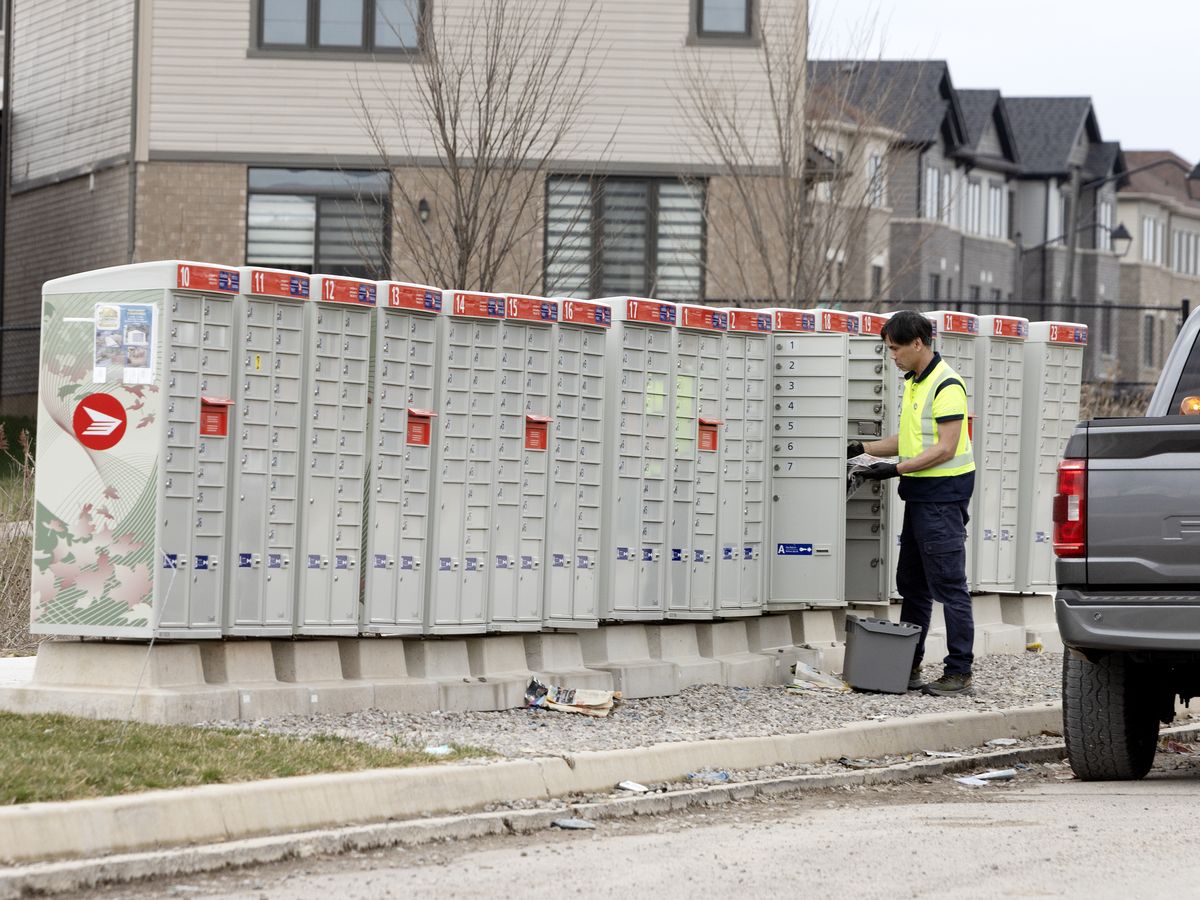
For years, Canada Post Corp. has been drowning in debt amid rising operating costs, competition from private delivery giants and a drastic plunge in letter mail volumes. On Thursday, Canada’s biggest postal operator laid out its five-year plan to convert addresses that receive door-to-door delivery to community mailboxes and modernize its retail network by closing some post office locations. Here’s how these changes could be implemented, where Canada Post stands in its decision and what it means for businesses.
Why is Canada Post making these changes?
In November 2025, Canada Post reported a record loss before taxes of $541 million, which it said was the largest quarterly loss in the company’s history. While it blamed labour uncertainty for driving its customers to competitors, Canada Post’s financial problems had been building for years — it had racked up more than $5 billion in losses since 2018 amid plummeting mail volumes.
“Canada Post is a very sick company,” said Marvin Ryder, an associate professor at McMaster University’s DeGroote School of Business. “If this was a private sector company, I would describe it to you as being in a death spiral.”
However, as a federal Crown corporation it has benefited from two billion-dollar bailouts from the Government of Canada in the past two years to keep it operational, Ryder said.
“No post office in the world has been allowed to die,” he said. “But the government does not want to keep pouring money at the rate of a billion dollars a year into the corporation, so it needs to do dramatic
restructuring
.”
In September, Joël Lightbound, minister of government transformation, public works and procurement, called for a series of measures to modernize the company and stabilize its finances amid an “existential crisis.”
Lightbound said converting the remaining four million addresses that currently receive door-to-door delivery to community mailboxes would generate nearly $400 million in savings each year. He also said adjusting delivery standards so that non-urgent mail can move by ground instead of air will save the corporation more than $20 million each year.
He added the government would lift the moratorium on rural post office closures, which was first imposed in 1994 and covers nearly 4,000 locations.
Ryder said the plan won’t necessarily turn Canada Post into a healthy, profitable company, but is “a step in the right direction.”
In April, following initial meetings with its unions,
Canada Post unveiled a five-year plan for community mailbox conversions and to modernize its retail network. The corporation said its retail revenue has dropped 30 per cent since 2021 as Canadians visit post offices less frequently and make fewer in-store purchases.
Are there problems with installing more community mailboxes?
It is clear from existing literature that community mailboxes will save money but the proposal raises important questions about how they will be implemented, said Richard Shearmur, a professor at McGill University’s School of Urban Planning in Montreal.
About three-quarters of Canadians already get their mail through community, apartment or rural mailboxes, while the remaining quarter receive door-to-door delivery.
Densely populated cities will require a large number of community mailboxes to be installed, Shearmur said. He estimated there could be one mailbox “about the size of a bus stop” per block with about 100 individual compartments. If these mailboxes are placed along sidewalks, it could increase congestion and create obstacles for pedestrians, particularly those with mobility devices or strollers.
In its April update, Canada Post acknowledged that converting dense urban core areas comes with additional challenges, and pushed the timeline for such areas to “later stages of the multi-year conversion program.”
Outside cities, Canada Post said it would protect access to “vital postal services in rural, remote and Indigenous communities,” but planning the location of community mailboxes will be key, said Shearmur.
“The question is: Is the community box going to be in the village, or is it going to be at the intersection of the Trans-Canada Highway?” Shearmur said. “That makes a 30-kilometre difference.”
The Canadian Postmasters and Assistants Association (CPAA), a postal union that works in more than 3,000 rural post offices across the country, said in an email that though details of the transformation plan remain limited, “we understand that the intention is that service in rural, remote, and Northern communities will be protected.”
CPAA’s national president Dwayne Jones said demand for postal services has continued to climb in rural and remote communities. And those residents already rely on centralized delivery models, including post office pick-up at a CPAA office, he said.
“The more significant issue is ensuring continued access to a local post office and maintaining reliable service overall,” he said.
How far apart is Canada Post from its unions’ positions?
In March, Canada Post said it was taking steps toward its proposed plan, starting by reaching out to its unions.
“We are preparing for consultations regarding transformation initiatives with our unions,” said a Canada Post media spokesperson in an email. “We want to conclude those important initial discussions before we share more details publicly.”
Currently, CPAA’s Jones said the union will be actively participating in the consultations and is seeking further clarity on how assessments will be conducted, what criteria will be used and how community input will be considered.
In September, following Lightbound’s announcement about the proposed changes, the
Canadian Union of Postal Workers
(CUPW) called the announcement an “attack on good jobs and public services” and launched a strike in protest.
McMaster’s Ryder said Canada Post’s current priority is likely the upcoming ratification votes with the CUPW regarding workers’ wages and benefits, before its consultations over the restructuring changes.
“This is not the right time to consult,” the CUPW said in March in its response to Canada Post’s March update. “This latest move by Canada Post and the government is yet again another attempt to derail our (labour) negotiations process.”
CUPW further noted that it had been four months since Canada Post provided an outlined plan to the government, which has not yet been made public or accessible to the union.
How long could it take to install community boxes and do municipalities have a say?
In April, Canada Post
said
it expects its national conversion program to take about five years, with different areas moving to community mailboxes each year. It is initiating discussions with 13 communities that contain about 136,000 addresses in total, such as Ottawa, Sept-Îles, Que., and Winnipeg.
Canada Post expects to begin conversions in late 2026 and early 2027, adding that a conversion from home delivery to a community mailbox typically takes months.
But McGill’s Shearmur said it could take significantly longer if Canada Post wants to organize discussions with representatives of municipalities and groups that may be affected by its proposed changes.
“If they want to roll it out in the next 24 to 48 months without doing that, I think that there will be a lot of opposition, but they ultimately do have the power,” he said. “They’re under financial constraints, and so they’re in a difficult place, too.”
Canada Post has the legal right to progress with its plans without listening to municipalities, as long as it can justify the changes are important for postal delivery, Shearmur said, though he added such a move would be damaging.
How could these changes affect businesses?
The transition to community mailboxes would have little impact on most businesses, as many have already switched to Canada Post’s competitors amid service disruptions and speedier delivery options elsewhere, McMaster’s Ryder said.
However, private shipping and delivery companies mainly operate in urban and suburban markets, he added. Canada Post, on the other hand, is mandated to serve every household in Canada, including in rural areas, and charges lower rates compared with its competitors.
“It’s going to hit rural businesses harder,” said Shearmur. “Small businesses do not have access to these alternative private services, because it’s just not commercially viable for these services to work in rural areas.”
Dan Kelly
, chief executive of the
Canadian Federation of Independent Business
(CFIB) said in an email that the CFIB is “generally supportive” of this change. Since households that already receive mail through community mailboxes still have larger packages or those that require a signature delivered to the door, the impact to businesses should be “fairly small” if this practice continues, Kelly said.
Another potential change that could benefit small businesses is weekend parcel delivery, Kelly said. Canada Post’s latest update on its negotiations with CUPW included a tentative agreement regarding a weekend parcel delivery model (Canada Post currently makes deliveries Monday to Friday).
The other part of the restructuring plan includes closing some post office locations. Canada Post said it would start with post office closures in urban and suburban areas that are currently over-served, and is conducting market reviews to gather data on local post offices.
Ryder said this could possibly lead to more postal kiosks opening in retailers instead.
While Canada Post could benefit from the cost savings, Ryder said the addition of a kiosks could also improve convenience for consumers and increase foot traffic in stores.
However, there are other, less tangible consequences for small-town communities that rely on the post office.
“Since the moratorium was lifted, a number of CPAA offices have already closed or have been under consultation for closure,” said Jones, calling for guardrails to protect rural service.
“For many communities, the post office is a critical piece of infrastructure that supports access to essential goods and services, small businesses and community connection, and in some cases, represents the only local access point for government and financial services.”
• Email: slouis@postmedia.com
Canada Post, union reach tentative deal ahead of holidays
Canada Post workers to stop delivering flyers in latest strike escalation